If you turn off King's Parade into St Edward's Passage, Cambridge changes scale. The famous colleges are still a few feet away, but suddenly the interesting things are smaller: a painted shop sign, a stack of hardbacks outside a doorway, the question of whether somebody has a first edition hidden behind the counter. Two independent booksellers live on the same little street. Neither feels like anything a search algorithm could have arranged.
It's a four-stop crawl with distinct reasons to visit, followed by one out-of-town bonus.
The four-stop route, with no rushing
| Stop | Address | Look for |
|---|---|---|
| 1. G. David | 16 St Edward's Passage | Antiquarian books and old maps |
| 2. The Haunted Bookshop | 9 St Edward's Passage | Illustrated and children's books |
| 3. Bodies in the Bookshop | 1A Botolph Lane | Crime fiction new and old |
| 4. Amnesty International Bookshop | Mill Road | Unpredictable donated books |
Start with the pair on St Edward's Passage, walk south towards Botolph Lane, and make Mill Road your final, longer leg. If you're only out for an hour, do the first three. If you want an afternoon with a satisfying wander at the end, all four make sense.
1. G. David: a hundred years of bookselling

Start in St Edward's Passage, in the little lane where bookshops feel oddly inseparable from the stone buildings around them. G. David has the sort of windows that can send a casual wanderer down an unexpected historical rabbit hole. You'll find antiquarian books, fine bindings, natural history, science, travel and literature; the sort of objects that have had lives before reaching this particular shop.
The family story reaches back to 1896, when Gustave David began trading books on Cambridge Market. He later opened premises in the passage with his son Hubert. The present business is run by Gustave's great-grandson David Asplin and Neil Adams. It's a family history almost as interesting as some of the stock.
The International League of Antiquarian Booksellers lists normal Monday to Saturday opening, but warns the antiquarian department may close over lunch when staffing requires. If it's the rare material you're travelling for, ring ahead. A lovely old bookshop is still an actual small business.
Check the bookshop's own details before visiting. Address: 16 St Edward's Passage, Cambridge.
2. The Haunted Bookshop: the wonderful little red door

Only a few steps away is a red door that seems to have been borrowed from a story. Behind it, Sarah Key Books specialises in children's and illustrated books, often older and unusual editions, alongside poetry, literature, binding and printed oddities. If you love illustrations almost as much as the stories they accompany, this is the room to linger in.
Sarah Key founded her bookselling business in 1987 and took over the Haunted Bookshop premises in the early 1990s. In a local interview she talked about the pleasure of stumbling upon something wonderful instead of entering a title into a search field. The story of a ghostly woman in white is part of the shop's folklore, not something a guide should pretend to have verified.
The shop's own webpage lists Monday–Saturday hours, while the professional PBFA membership listing mentions shorter or variable opening. That makes a quick phone call sensible if you're planning a special trip. A specialist bookshop is very different from a big retailer with a rota of staff.
Check the bookshop's own details before visiting. Address: 9 St Edward's Passage, Cambridge.
3. Bodies in the Bookshop: Cambridge's specialists in murder
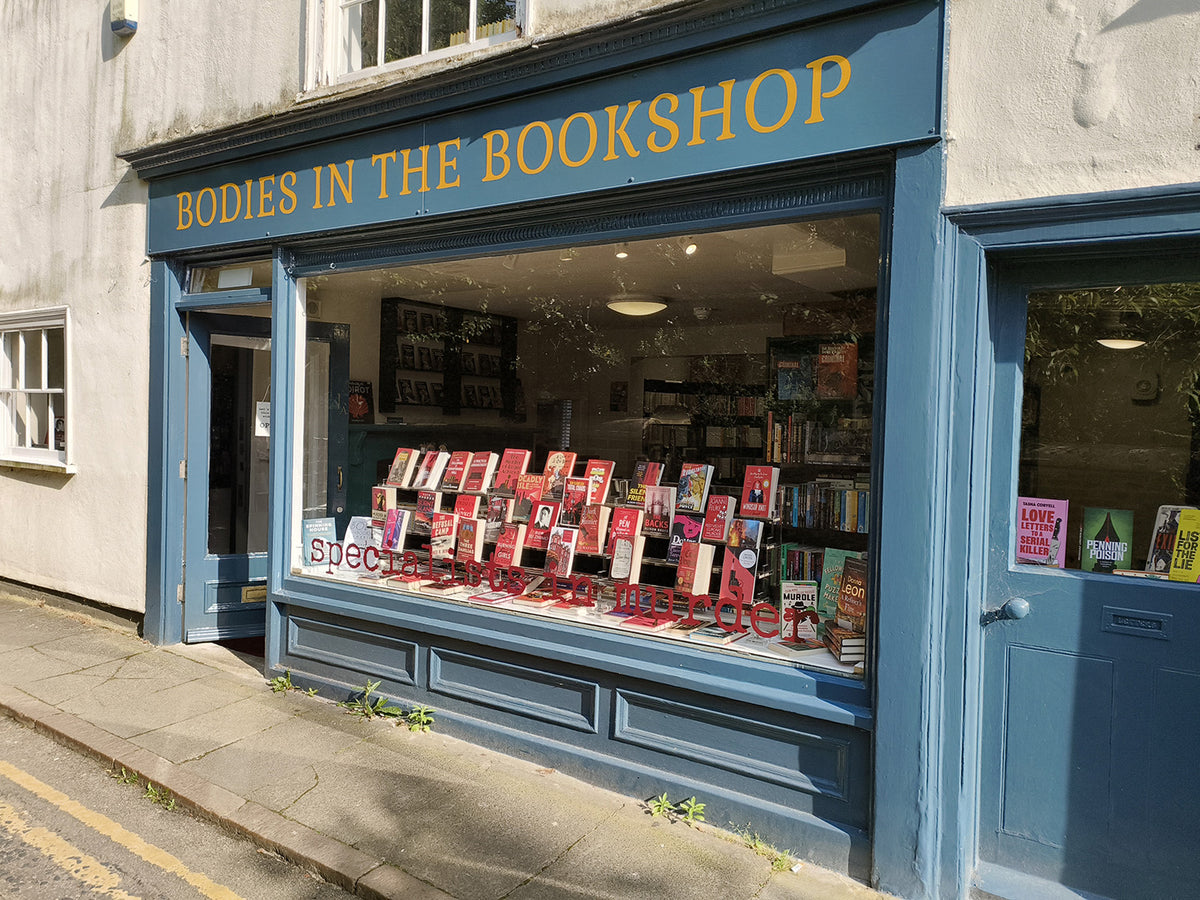
Head south towards Botolph Lane and a blue shopfront devoted to murder. Bodies in the Bookshop specialises in crime fiction, from intricate Golden Age puzzles to modern suspense and thousands of secondhand titles. It is a brilliant idea for a shop precisely because it refuses to be all things to all readers.
The bookseller Richard Reynolds had spent decades specialising in crime fiction at Heffers before joining publisher Jon Gifford of Oleander Press to establish this independent shop. The shelves have both curatorial knowledge and an affection for mysteries with actual histories behind them. You can arrive as a casual reader and leave with a detective you've somehow never met.
Its calendar includes author gatherings and literary events, so it's worth checking more than the everyday opening hours. The October 2026 homepage temporarily lists Thursday to Saturday only until 13 October. That's not a permanent schedule to copy into a guide; check the shop's own notice before walking across town.
Check the bookshop's own details before visiting. Address: 1A Botolph Lane, Cambridge.
4. Amnesty International Bookshop: the treasure of other people's books

The final stretch takes you beyond the postcard centre to Mill Road and a wonderfully unpredictable shop run by volunteers. Opened in 1998, the Amnesty bookshop is supplied by donations rather than a publisher's new-release schedule. Its stated strengths include philosophy, art, history, social sciences, Greek and Latin, sheet music, maps and foreign-language volumes.
There's something especially good about donated books in a university city. A book might have come from a retired academic, somebody's overgrown collection or a reader who simply needed more room. You won't know until you look. Purchases also support Amnesty's work, giving the afternoon a purpose beyond adding to your own shelves.
Amnesty currently lists Monday to Saturday 11 am to 5 pm and Sunday noon to 4 pm. Because Mill Road is a longer leg from the first three stops, check ahead, especially on holidays or when the weather is less hospitable.
Check the bookshop's own details before visiting. Address: Mill Road, Cambridge.
One extra place worth its own journey
Emmaus Cambridge in Landbeach has a large donated-books operation. The organisation describes a remarkable volume of books passing through its hands, many from local and university collections. Its shop is not a fifth stop on a city-centre walking route; you need to travel outside central Cambridge. But if rummaging through unexpected secondhand books is your joy, it's a worthwhile separate idea.
How to browse without buying four books you don't need
Give yourself one tiny challenge per shop. At G. David, look for a book older than you. At the Haunted Bookshop, open something purely because of its illustrations. At Bodies, ask about a mystery writer whose name you haven't encountered. At Amnesty, choose a section you would normally walk past. The point isn't filling a bag, it's finding a trail your own curiosity wants to follow.
Look carefully at condition and price, particularly with collectible books. Don't pull fragile volumes from a shelf by the top of the spine, and ask before taking photographs inside. An independent bookseller may be happy to help identify an edition or explain a binding, but they also have a working shop to run.
A little reading life when you get home
I like the idea that the walk doesn't end when the shops close. Save a name or a book you couldn't afford this time in Calphii's Inbox. Give your browser room a quiet bookish scene with Visuals, and keep a note open beside whatever you're reading. It's a little corner for discovering something, rather than responding to demands.
Leave enough time to be surprised. The best part of a secondhand bookshop walk is often a title you hadn't planned to look for, found on a shelf you'd normally pass by. There is no need to rush the last stop just to finish the route.
Cambridge has no shortage of books you can order. Its independent bookshops offer something much rarer: the chance to find one you didn't know you wanted.