One of the nicest things about Cambridge is how close extraordinary science sits to ordinary life. You can spend the afternoon buying toothpaste, then head west after dark and stand beside a nineteenth-century telescope, waiting for the clouds to move. Nobody expects you to know what a nebula is before you arrive.
The Institute of Astronomy, just off Madingley Road, opens its doors to everyone on Wednesday evenings between October and March. There is a researcher giving a proper talk, equipment old and new, and, with some cooperation from the sky, a chance to look through a telescope yourself. It costs nothing. You don't need to be a university student.


The essentials
| When | Wednesdays, October to March; the programme runs 7–9 pm. Doors at 6:30 pm, talks at 7:15 pm. |
|---|---|
| Booking | Free, and none required for individual visitors. Organised groups of more than 15 need to enquire in advance. |
| Where | Institute of Astronomy, Madingley Rise, west Cambridge; not in the historic city centre. |
| Watching | Historic telescopes and modern instruments when weather allows; alternative astronomy activities when it doesn't. |
| Official programme | Current astronomy talks and dates |
What actually happens on a Wednesday evening
The doors open at half past six
Go a little earlier than you think you need to. The public talk starts at 7:15 pm, but seats are allocated on arrival. The Institute says it tries to provide an overspill room with a stream of the talk if the main lecture theatre fills up. It's a public occasion, not an invitation-only college gathering. The people in the audience will range from curious first-timers to astronomy enthusiasts who know far more than you or I.
Children are welcome, although the organisers point out that some lectures can be rather advanced for younger listeners. Half-term sessions tend to be more suitable for families. There's no exam to pass at the door and no reason to pretend you understand a term you haven't heard before.
At 7:15, an astronomer takes you somewhere else
The talks last about half an hour. One week might be about distant galaxies; another might explain why a black hole isn't simply a giant cosmic vacuum cleaner. The 2026–27 season begins on Wednesday 14 October, with later October dates covering measuring distances in the universe and cosmology. The list of speakers is available from the Institute's own events page, which is a better source than a months-old poster.
Part of the pleasure is being in a room with somebody who spends their working life puzzling over these questions. University research can sometimes seem locked behind dense papers and serious-looking websites. Hearing someone explain it to the neighbours is a different sort of access.
After the talk, the clouds get a vote
On clear evenings, the Institute opens its historic Northumberland and Thorrowgood telescopes for observing. Members of the Cambridge Astronomical Association may also put modern instruments on the lawns, sharing projected views and explanations. Imagine walking out of the lecture theatre and joining a little queue beneath the night sky, everyone waiting to see what the eyepiece reveals.
But there is no guarantee. The organisers make a weather decision around 6:45 pm; cloud, rain, mist or strong winds can rule out outdoor observing. When that happens, the evening isn't wasted. They offer tea and biscuits, sometimes with additional astronomy activities and conversation. You can go home knowing something you didn't know when you arrived.
If you only want the observing and would rather skip the lecture, the Institute asks you to arrive at 7:45 pm, not earlier, because the telescope team is still setting up. If the sky is completely overcast, remember that a telescope cannot make the clouds transparent.
Meet the historic Northumberland Telescope

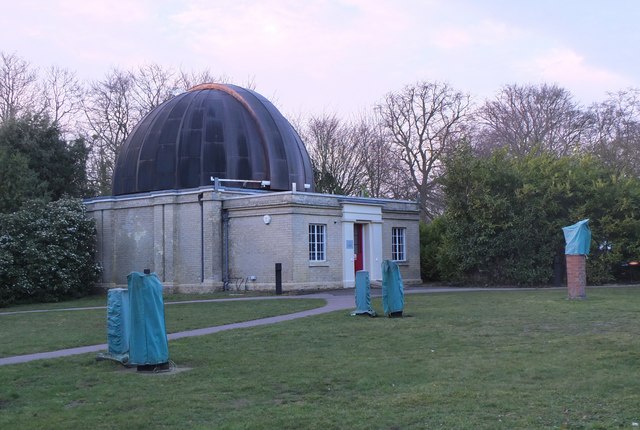
There's something deeply appealing about an astronomical instrument so large it needs a building of its own. The Northumberland Telescope belongs to Cambridge's long history of observing the sky with precision, patience and an impressive amount of metalwork. An old refractor isn't just an artefact in a case. On suitable public nights, you may be able to look through instruments whose design comes from an entirely different age of astronomy.
Modern astronomers work with astonishing digital images and huge datasets. Standing inside an old dome is a reminder that the work once meant aligning heavy instruments, turning mechanical controls and watching the night go by in person. The telescope itself is part of the experience, even before you look through it.
The questions people quietly wonder before going
Do I need to know anything about space?
No. This is public outreach, built around the idea that astronomy belongs to curious people outside the department too. Ask what you're looking at, how far away an object might be, or why the moon seems much bigger when it's close to the horizon. Questions make an evening like this, not spoil it.
Will I definitely see Saturn or Jupiter?
Not necessarily. Whether a planet, moon or star is visible depends on the season, the time and the equipment in use. If you go expecting a specific picture from a textbook, you're setting yourself up for disappointment. The better approach is to let someone show you what's actually there.
Could I watch the talk without leaving home?
Yes. The Institute says it streams the talks live and keeps an archive of recordings. There are links on its official open-evenings page. You'll miss the fresh air and the telescope, of course, but not the entire chance to learn.
Getting there without a surprise
For reliable directions, use the Institute's official visiting guide. There are three car parks along Madingley Rise and a parking space for disabled visitors near the main entrance. The organisers explicitly ask people not to park on the verges or pavements. Allow a few minutes' walk rather than expecting to step out of the car directly into the lecture room.
The building, lecture theatre, outdoor observing area and one of the two historic telescopes are described as wheelchair accessible. If you have specific access needs, check with the organisers first. That's more useful than assuming that access to one building means access to every instrument.
Bring layers. A classroom can be warm while an observatory lawn in November feels positively polar. A small torch can help with paths, but the organisers ask that its light be covered in translucent red material. Bright white light can ruin people's night vision just as they're about to look through a telescope.
A tiny bit of preparation, without turning it into homework
If you feel like learning a little before you go, try one of the free online planetariums. Set your location to Cambridge, choose the evening's date, and find a single constellation. That's plenty. Or save the date and a question you're curious about in Calphii Inbox, where you can leave the thought for later.
Afterwards, Calphii's Living Universe Vibe can fill your browser workspace with drifting stars, moons and occasional shooting stars while you read more. It's intentionally an atmosphere, not a mathematically accurate sky map. And its optional Night Shift gently dims and warms the room after sunset, which feels fitting for an evening that begins when the day has let go.
An extraordinary room with an ordinary door
Cambridge can sometimes make its most wonderful places seem reserved for people with a particular college card. The Institute of Astronomy does something quite different every Wednesday in the colder months. The doors open, somebody starts talking about a universe much bigger than any of us, and strangers stand together hoping for a break in the clouds.
You don't need a telescope, a degree or a ticket. You just need to check the programme, put on a coat and see what the night has planned.