Indie games · Unusual worlds · October 2026

8 Weird Indie Games With Worlds You Won’t Forget

Graffiti under nightclub lights. A completely unhinged old internet. A pop album you can steer through. Eight games that couldn't have come from anyone else's imagination.

Not every game worth falling for is relaxing. Some make a mess. Some leave you staring at the wall for ten minutes. Some look as though they were drawn in somebody's school notebook, then quietly reveal how much care has gone into every inch.

We've already written about ten cosy indie games and the little studios behind them. This is the other side of that conversation. The fluorescent, grubby, funny, occasionally unsettling side. Games made by people with such specific ideas that sanding off their edges would remove the reason to play them in the first place.

We'll begin with a nightclub puzzle from Suffolk's Miracle Tea, then visit a graffiti-covered island, build a friend from bones, investigate a fictional 1999 internet and take a crooked road trip through the nineties. After that, things get louder and a little more emotional. They're not all unknown cult curiosities, and they aren't all similar genres. The thread connecting them is authorship: you can feel somebody's particular taste in the world they've made.

Which strange little world should you step into?

For clever puzzles and loud style: Club Soko. For wandering and graffiti: SLUDGE LIFE. For an eerie, tender hour: Birth. For digital detective work: Hypnospace Outlaw. For 90s comedy: The Big Con. For absurd British humour: Thank Goodness You're Here!. For a pop-music rush: Sayonara Wild Hearts. For a story that stays: 1000xRESIST.

Club Soko's purple-lit underground dance floor with clubgoers, bouncers and a tiled puzzle area
Gameplay screenshot: Miracle Tea

01 / 08 · A nightclub that makes you think

Club Soko

Miracle Tea · Suffolk, England · 2026

Some puzzle games greet you with white tiles, quiet music and the reassuring impression that nothing here could ever spill a drink. Club Soko has gone in the opposite direction. The floor is sticky, the people are in your way, the security staff look unimpressed, and somewhere beyond the crowd is a perfectly good wall that Maude intends to cover in graffiti.

Under all that attitude is Sokoban: the beautifully cruel puzzle language of pushing things around a grid, then discovering you have pushed one particular thing into exactly the wrong square. Here those obstacles have personalities. Bouncers, clubgoers and the strange furniture of a night out become part of a route through the building. What makes the idea appealing isn't simply that a club is an unexpected setting. It's that the setting gives a familiar puzzle mechanic a reason to exist. Every tiny grid feels like somebody's bad Friday night.

The art belongs to the same world as old underground comics and early-2000s Flash games: huge expressions, dirty purples, sickly neon, funny little bodies. The soundtrack isn't just polite background accompaniment, either. Miracle Tea has built six chapters around their own music, alongside more than a hundred handcrafted puzzles, cameo characters from other independent creators and, gloriously, a toggle for the game's puke. There's even a chill music mode. It's a studio based in Suffolk making something with a very definite accent, rather than another puzzle game trying to look universally tasteful.

And the puzzles may properly stop you. An undo system makes experimenting less punishing, but clever movement still matters; don't buy it expecting a passive animated nightclub tour. For the curious, the developers offer a browser-playable version, so you can meet Maude and try the rhythm of the puzzles before committing to the full game. Club Soko earns the first spot because its oddness is not a costume placed on an ordinary game. The oddness is the design.

Play it when you want an inventive puzzle with a grubby, funny, unmistakable sense of place. Skip it tonight if repeated trial and error is the last thing your brain needs.

A bug-eyed figure relaxing in a folding chair on a graffiti-covered rooftop in SLUDGE LIFE
Gameplay screenshot: Terri Vellmann / Doseone / Devolver Digital, via PC Gamer

02 / 08 · Loitering as an art form

SLUDGE LIFE

Terri Vellmann & Doseone · 2021

A polluted little island. A corporation called GLUG. People standing around looking like they haven't had a decent night's sleep since the millennium. And you, an aspiring graffiti artist named GHOST, with more freedom than anyone should sensibly give you. SLUDGE LIFE understands that sometimes the most interesting thing to do in a game is absolutely nothing productive.

You wander in first person, climb wherever looks climbable, find places to tag, meet peculiar locals and slowly work out how the island fits together. There are goals and several possible conclusions, but the attraction is often whatever happens between them: a suspicious rooftop, a tiny room you nearly missed, a bit of conversation that adds very little to your objectives and quite a lot to the atmosphere. It's exploring for the sake of poking around.

Artist and developer Terri Vellmann and musician Doseone make the world feel deliberately unfinished in the best way. Hard edges, strange proportions, toxic greens and muddy colours turn industrial ugliness into visual personality. The music helps sell its particular rhythm, too. This isn't a glossy cyberpunk city asking to be admired from a distance. It's an extremely questionable neighbourhood that rewards you for getting your shoes dirty.

There is a small but important distinction between it and Club Soko. Both feature graffiti and underground culture; Club Soko gives that spirit tight rules, while SLUDGE LIFE lets you wander off and make your own trouble. Players who need a strong narrative direction may find it aimless. Its drug references, coarse humour and deliberately grimy atmosphere are not decorative warnings, either. But if you love discovering what an artist has hidden in an unlikely corner, it is an unusually good place to be nosy.

Choose this for free-roaming exploration and strange people, not for a neat quest checklist or pristine, comforting scenery.

A delicate hand-drawn typewriter wrapped in trailing leaves inside Birth
Gameplay screenshot: Madison Karrh

03 / 08 · A little love story made of spare parts

Birth

Madison Karrh · 2023

The premise is almost too sad to write plainly. You are lonely in a city, so you decide to assemble a companion out of the bones and organs you find around you. In somebody else's hands, that might become a gruesome joke. Madison Karrh's Birth is much quieter, far stranger and surprisingly tender.

You explore illustrated museums, shops, libraries, cafés and other little rooms, solving tactile puzzles to collect the parts you need. A drawer becomes a miniature mystery. An object which looked like scenery turns out to move. You start seeing each room not as a backdrop but as a small collection of things somebody lovingly put there for you to touch. The point-and-click structure keeps the experience intimate; it rarely asks you to think beyond the next curious object.

Its drawings are the reason you'll remember it. Thin, wandering black lines sit against chalky colours. People and objects look fragile and faintly uncomfortable. The anatomy is odd, but the loneliness underneath it is instantly recognisable. Even the cafés and bookshops have a peculiar hush to them, as though the whole city is waiting for an absent person to arrive. That tension between macabre subject matter and delicate presentation gives Birth an emotional tone that's difficult to classify.

This is not a huge world to get lost in for weeks, and you shouldn't expect every interaction to become a deep mechanical puzzle. Some of the pleasure is simply noticing that an object responds at all. The unsettling imagery may be too much for someone who wants a purely cheerful game, despite how gentle much of it feels. But if you like the idea of a hand-drawn cabinet of curiosities that happens to be about wanting somebody near you, there are few games quite like it.

A lovely choice for a quiet, slightly eerie evening of observation and clicking. Less suitable if bones, organs or melancholy imagery bother you.

A neon pink 1999-style Hypnospace Outlaw desktop, with a QuickCHECK window open over a homemade website
Gameplay screenshot: Tendershoot / No More Robots, via Steam

04 / 08 · Remember when the internet had weird little corners?

Hypnospace Outlaw

Tendershoot, Michael Lasch & ThatWhichIs Media · 2019

There was a time when visiting somebody's corner of the internet meant discovering their taste in fonts, background music, animated GIFs and things they had absolutely no business putting on a public homepage. Hypnospace Outlaw takes that feeling, invents an alternative 1999 and builds an entire detective game inside it. The twist: people browse this internet while asleep, and you've been hired to police it.

You're an Enforcer, which sounds impressive until you realise much of the job involves wandering from homemade page to homemade page looking for copyright infringements and other violations. But the assignments are really an excuse to learn how this miniature society works. A musician's site, a local argument, a dodgy download and an inexplicably elaborate fan page can all contain clues. The internet itself is the puzzle. You read, follow links, search for names, fiddle with your pretend desktop and gradually notice connections the task list didn't spell out.

Creator Jay Tholen and collaborators have made more than a collection of retro jokes. The amateur graphics, embarrassing little songs and strange virtual personalities accumulate into something surprisingly human. People don't seem to exist solely to give you clues. They have obsessions, insecurities, friendships, grudges and too much freedom with their homepage layouts. That is why its nostalgia works even if you were too young to remember dial-up: it's not only about old technology. It's about the messy people who used it.

The practical warning is simple: there's a lot to read. Progress sometimes means knowing which word to search for, which tiny detail to remember and which strange file to investigate. If a game consisting largely of browsing websites sounds unbearable, trust that instinct. If your favourite childhood computer memories involve losing two hours to something nobody else seemed to know existed, this might feel less like playing a game and more like finding an old door to the internet that got boarded up.

Best for curious readers, digital archaeologists and anyone who loves a mystery assembled from tiny clues. Not a low-effort evening if you're tired of screens and reading.

The Big Con's fluorescent 1990s shopping mall, full of bright clothes and eccentric characters
Gameplay screenshot: Mighty Yell / Skybound Games

05 / 08 · A VHS-coloured road trip with bad ideas

The Big Con

Mighty Yell · Canada · 2021

If somebody drew the entire 1990s from memory after watching too much Saturday-morning television, it might look like The Big Con. Everywhere there are eye-watering colours, malls, payphones, VHS tapes, scrunchies and people who look just suspicious enough to be carrying money. It's a road-trip comedy with a criminally soft centre.

You play Ali, a teenager who ditches band camp to save her mum's video store from loan sharks. Her plan involves travelling across America and learning how to pick pockets, overhear conversations, disguise herself and talk her way into various people's wallets. It's a wonderfully dubious engine for a coming-of-age story. One moment you're trying to work out how to lift cash unnoticed; the next, the real point is that Ali loves her mum and doesn't quite know how to fix what is happening at home.

Mighty Yell leans into the visual language of a 90s cartoon without merely applying a purple filter to modern nostalgia. Sharp outlines, oversized shapes and a colour scheme that refuses to calm down make shops and stations feel like places you want to inspect. The dialogue is knowingly silly, and the choices sometimes ask whether a stranger really deserves to be conned. You're not meant to mistake this for an ethics course, but you're not simply a cash vacuum either.

There's a thoughtful practical detail worth mentioning. The studio documents accessibility options including a way to bypass the pickpocket timing mini-game, visual hints and objective reminders. That's a welcome recognition that enjoying a character-driven romp shouldn't require loving every reflex test. On the other hand, the central routines can grow repetitive, and some players will find the 90s references relentless. Come for the roadside characters and mother-daughter story more than the promise of a mechanically complex heist simulator.

For an upbeat evening of cartoon crime, jokes and a story with heart. Less convincing if you're chasing intricate stealth systems or enormous player freedom.

The tiny yellow-shirted visitor in a surreal pastel butcher shop in Thank Goodness You're Here!
Gameplay screenshot: Coal Supper / Panic

06 / 08 · A very strange afternoon up North

Thank Goodness You're Here!

Coal Supper · United Kingdom · 2024

A travelling salesman arrives early for a meeting in the fictional Northern English town of Barnsworth. Naturally, the locals treat this as an opportunity to make him do everything they've been putting off for years. The resulting game is best described as being trapped inside a deeply peculiar British cartoon in which your main qualification is looking available.

Thank Goodness You're Here! calls itself a slapformer. You run, jump, explore, talk to people and smack or prod things until another ludicrous situation unfolds. The pleasure isn't mastering a demanding control scheme. It's turning a corner and discovering that a completely unnecessary joke has been waiting there all along. Coal Supper's town is compact but dense with visual gags, memorable voices and a cast of residents whose problems only become more absurd when you try to help.

The drawings have the confidence to be unattractive in extremely funny ways. Rosy faces, oddly elastic anatomy, shop interiors packed with alarming food and those unmistakable little details of British high streets give Barnsworth a texture that a photorealistic town would never achieve. The humour is local without being sealed off. Some jokes land harder if you know Yorkshire, but anyone who understands the experience of being recruited for an unwanted errand will recognise the situation.

Comedy is also the most personal taste on this list. If surreal, gross-out or cheekily rude British humour makes you roll your eyes, no amount of praise for the art will rescue it. Steam flags nudity or sexual content and general mature material; it's not a family-friendly cartoon simply because it's colourful. But if you're in the mood for an afternoon in which each small action might unleash another ridiculous bit of animation, few games commit to the bit so completely.

Perfect when you want laughter, strange drawings and a short adventure that doesn't demand strategic mastery. Check the mature-content note if playing with children.

Two motorcycle riders speeding through a magenta neon city in Sayonara Wild Hearts
Gameplay screenshot: Simogo / Annapurna Interactive, via PC Games

07 / 08 · When a pop album becomes a place

Sayonara Wild Hearts

Simogo · Malmö, Sweden · 2019

Where most games give you a soundtrack to accompany the action, Sayonara Wild Hearts seems to have started with the music and asked what kind of universe could fit inside it. You race through neon streets, steer motorcycles across impossible roads, fight, dance and leap from one extravagant image to the next. Just when a scene becomes familiar, it changes the rules and flies somewhere else.

The story begins with a broken heart and a masked rider known as The Fool. There's mythology and tarot imagery threaded through it, but you don't need to memorise any lore to understand the feeling. This is pop music rendered as motion: the rush of escaping somebody, the sudden high of reclaiming yourself, the melodrama of a night when every light seems personally aimed at you. A song ends, and so does the little level that belonged to it.

Swedish studio Simogo describes the work as a pop-album video game, and its own development notes are revealing. The team wanted an action game that could surprise experienced players without terrifying people who rarely play. So the controls remain fairly simple while the camera, scene and music do the wild things. It's an unusually generous design decision in a game this stylish; the spectacle doesn't depend on making every new visual trick into a new manual to learn.

It is also almost the polar opposite of the slower entries here. The colours are intense, movement comes quickly and chasing high scores can change the mood from dreamy to demanding. People sensitive to flashing visuals or fast motion should look closely at footage first. If you want a village to inhabit for a month, this isn't that kind of game. But as an evening-sized piece of audiovisual imagination, it makes a persuasive argument that a game can be the album cover, the song and the feeling of dancing alone in your room all at once.

For the night you want colour, music and momentum rather than a sprawling adventure. Better enjoyed with the sound on, and with care around visual intensity.

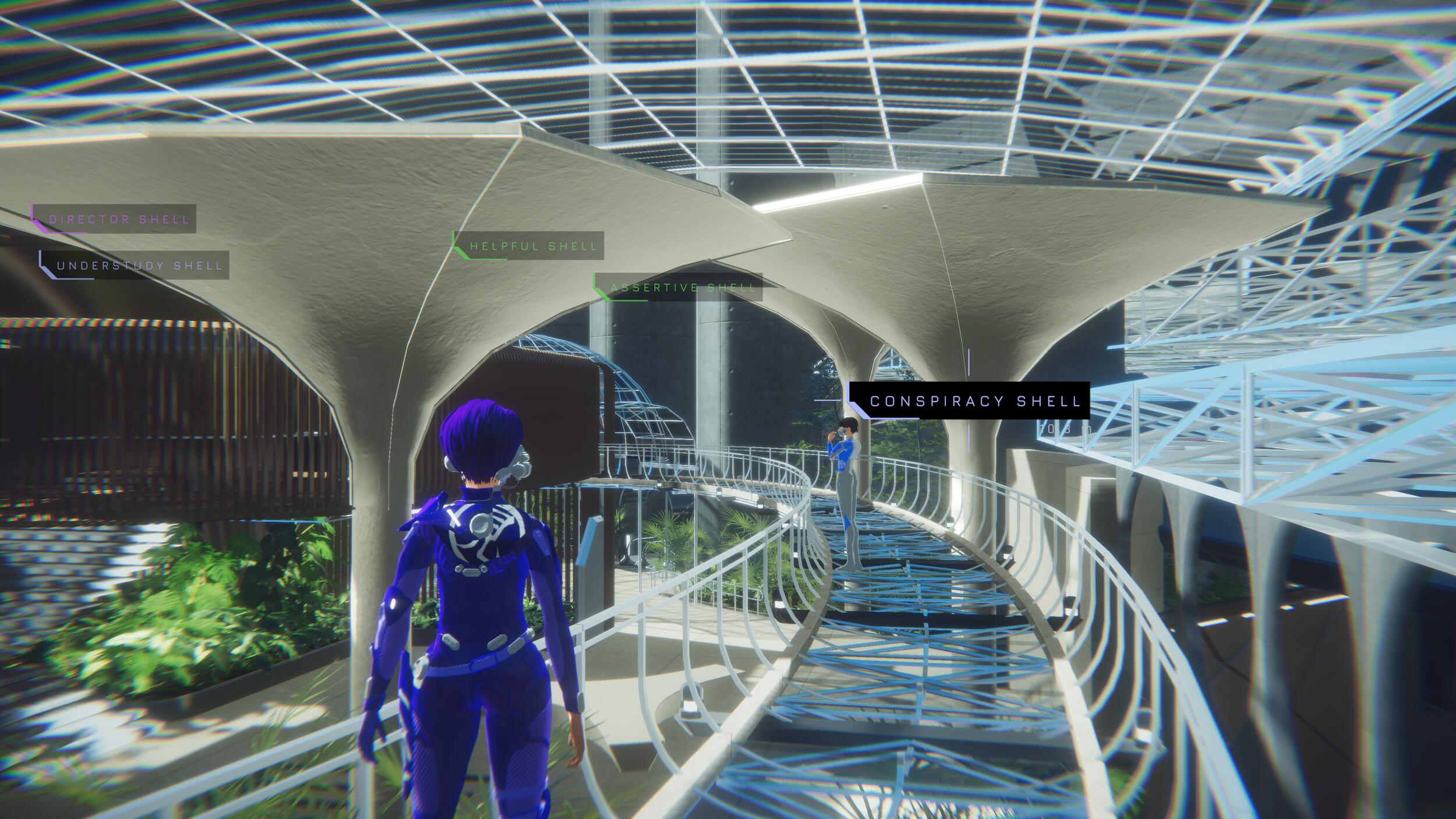
Watcher standing beneath sweeping futuristic walkways and luminous lines in 1000xRESIST
Gameplay image: sunset visitor / Fellow Traveller, via GamesRadar

08 / 08 · For the story you keep thinking about

1000xRESIST

sunset visitor 斜陽過客 · Vancouver, Canada · 2024

The last recommendation is here for a different reason. 1000xRESIST is not a place to potter, decorate or go looking for a funny secret in a cupboard. It's a science-fiction story with the ambition and emotional weight of a very good stage production, set in a future where humanity has been driven underground by an alien-borne disease.

You are Watcher, part of a society devoted to a mysterious figure called the ALLMOTHER. Memory is central to how this society understands itself, and the experience gradually asks you to reconsider what you thought you knew. The less you read about its plot in advance, the more room it has to work. Its structure moves between exploration, conversations, memories and staged sequences rather than settling into one familiar adventure-game format.

That theatrical quality is not an accident. Vancouver studio sunset visitor was founded by artists whose backgrounds include dance, theatre, film and experimental performance, and 1000xRESIST wears that history proudly. Figures stand in spaces that can feel more like installations than conventional game levels. Colour and movement carry meaning. Scenes are arranged to make you feel the distance between people, generations and versions of a remembered event. It's a reminder that an independent team doesn't need an enormous simulated world to make something feel expansive.

This is easily the heaviest recommendation here. The developers warn about trauma, disease, violence, body horror, suicide references, bullying, flashing lights and other mature themes. It's dialogue-rich, and its power depends on paying attention rather than dipping in for five minutes between other things. Some players will prefer a mechanically busier game; others will find the storytelling unforgettable. Include it in your plans when you want to give a piece of art a proper evening and perhaps a few days of thought afterward.

A serious, narrative-led choice for someone who values ambitious writing and visual direction. Not a soothing casual game; read the content warnings before starting.

What makes these worlds stay with us?

It's tempting to describe unusual indie games as weird for the sake of weirdness. But the best of them have a reason to look the way they do. Club Soko's crowded dance floor gives its grid puzzles attitude. Hypnospace Outlaw's headache-inducing webpages tell you exactly who lives behind them. Birth's fragile drawings make an upsetting premise feel intimate. In Sayonara Wild Hearts, movement, colour and music refuse to be separated.

That's the part we admire most: these games have not spent their lives trying to become all things to all people. If one leaves you cold, there's nothing to fix. Move along until you find the one with the particular strangeness you love. A recommendation is better when it helps you say no as well as yes.

A small note from Calphii

We make Calphii, a customisable room in your browser for getting on with work, studying, making things or simply spending time in a space that feels like yours. It isn't a game, and we're not going to pretend our Deep Focus timer has anything to do with defeating a bouncer. But we recognise the care that goes into atmosphere. In Calphii you can change Visuals, your music, ambient sounds and the little companions on your screen, because a digital place doesn't have to feel generic to be useful.

And then, when the work is finished, shut the task board, close the tabs and give yourself an evening in somebody else's world. If this collection was too noisy, our gentler indie-games list is waiting next door.

Where to find the games and the people behind them

Follow the game and studio links above for official availability, pricing and the creators' own words. Stores and platform availability can change. A small studio's own site, an honest review or a wishlist can be a more useful show of support than an impressive-sounding list nobody actually follows.

For Club Soko, the browser version on itch.io is a particularly good place to start. If you'd like a second opinion on its puzzle challenge, SIFTER's review is worth reading. You can also explore Simogo's unusually detailed development notes about how Sayonara Wild Hearts was made.