The hour when the world finally stops asking questions
The kitchen is dark, the street outside has quietened and your laptop is the brightest thing in the room. A book waits beside it, open to the same page you left at dinner. All afternoon you meant to work on it. Now the day is finally out of the way.
There's a particular appeal to studying after dark. Your phone isn't full of invitations, nobody needs a quick reply and the room starts to feel like a small country of its own. The problem is that the quiet can tip from peaceful into lonely. You miss the faint rustle of pages, the warm light from other desks and that comforting sense that you aren't the only person trying.
An online study room can borrow those details without making you travel across town to a library that's already locked its doors. The trick is to create an atmosphere you can actually work in, rather than an elaborate performance of being a night owl.
The best online study room at night isn't always a crowded one
Search for a late-night study room online and you'll find communities, 24-hour video calls, shared focus timers and digital cafés. Some are busy; some are quiet. Sometimes a whole group following the same clock is exactly what you want. Sometimes you just want a tiny corner and to be left alone with your notes.
Decide what kind of company would help tonight. If you're struggling to begin, visible people or a study-with-me video can give the session a friendly starting signal. If you're reading something difficult, a quiet room with no chat at all might be better. If you're exhausted, you may want to set a short limit, finish one piece of work and go to bed.
Don't confuse a room being open all night with a promise that somebody will always be waiting inside it. A lovely study space should still be useful when you're the only one there.
Choose a window that makes staying feel easy
One night, a rainy apartment is perfect. A warm square of light, the sense of weather on the glass and an imaginary city keeping its distance. Another night, you might prefer the clear quiet of an observatory, the glow of a distant city or a beautifully plain background that lets the book take up all your attention.
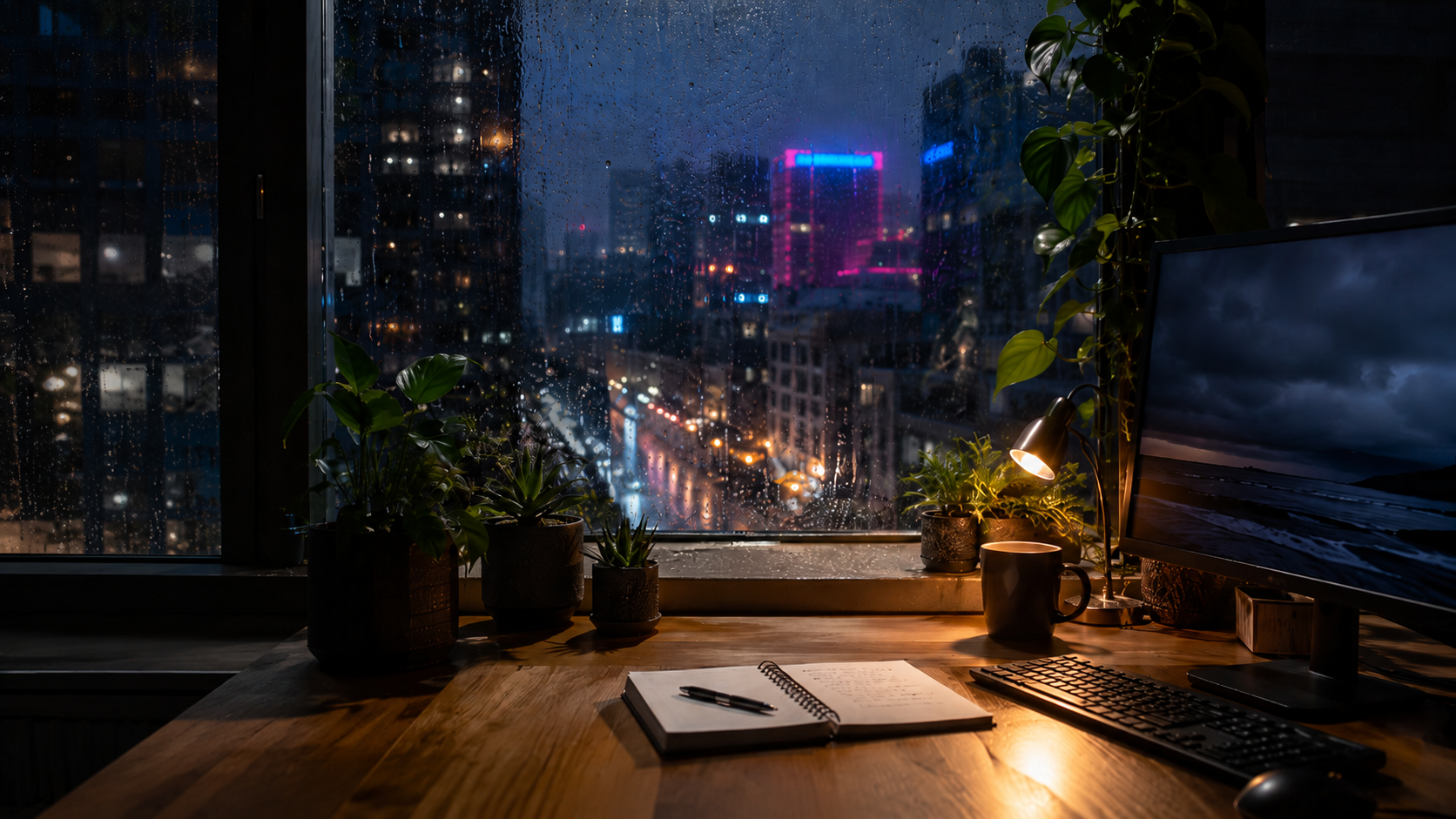
Calphii lets you choose a visual world for your own Space and arrange the widgets around it. You're not entering somebody else's fixed room. You're making a place that suits the kind of work you want to do, and you can save that arrangement for the next time you return.
Give the real material the best seat. If you're reading on the laptop, make the page comfortable to see. Put the atmosphere around the edges. A tiny timer or the next task can sit nearby, but an enormous countdown covering the window isn't compulsory.
Make a soundtrack that sounds like the room
Some evenings need almost nothing: gentle rain on a window, perhaps a very soft fire underneath it. Some need the faint sound of a café or familiar old music that seems to be drifting through the next room. There is something lovely about an ordinary desk that sounds as if it belongs to a place.
The best late-night ambience is often quieter than you expect. Start one sound at a low level. If the room still feels empty, add a second. Don't try to hear every texture at once. Your assignment should eventually be more interesting than the imaginary weather.
If you're reading or trying to remember a complicated explanation, lyrics may be more distracting than they were when you were filing notes earlier. For routine tasks, you might enjoy a fuller soundtrack. In Calphii you can adjust ambience and media separately, so the room doesn't have to take its mood from one unchangeable video.
Then leave the controls alone. A good soundtrack is the one you stop choosing and start living beside.
Three small late-night rooms to try
THE RAINY READING ROOM. Choose a warm indoor scene, quiet window rain and a chair with proper light over the book. Put the reading on the largest part of the screen. Set a thirty-minute timer if it helps, or read until the end of a section. Before closing the book, write two or three sentences from memory.
THE MIDNIGHT WRITING DESK. Pick a darker scene with a little glow at the edges. Keep a single writing document open and add low instrumental music if you like it. The first task isn't to make a perfect paragraph. It's to get a clumsy one onto the page so there's finally something to work with.
THE QUIET EXAM CORNER. Use clearer, brighter light in your actual room. Keep visual movement minimal. Put five practice questions in front of you and do them before you look at the answers. A soft soundtrack is optional. The room can be cosy without becoming sleepy.
All three use the same principle: one clear piece of work, one familiar setting and no need to spend half the evening decorating.
Quiet company is nicest when it doesn't demand your attention
The magic of a library isn't that everybody wants to talk. It's that one person is highlighting a book, somebody else is thinking over a problem, and the shared room gives the evening a gentle direction.
A study-with-me video can recreate a little of that feeling, provided you don't feel obliged to follow the creator's exact breaks. A virtual study room can do it too. In Calphii, Focus Together adds quiet presence, small reactions and a little conversation when you want it, while you keep your own backdrop, music and focus rhythm.
You don't have to turn on a camera or narrate what you've achieved. If nobody happens to be there, your room still works as a place to study. The atmosphere doesn't rely on having an audience.
If your friends are awake on the other side of the world, you can each choose your own pace. A short overlap can be sweet. But your essay doesn't need to wait for somebody else's evening to begin.
Give the night a gentle edge
There is a less romantic side to studying late: promising yourself one more hour, then looking up at two in the morning having read the same paragraph six times. The nice lighting doesn't make exhaustion disappear.
Choose a sensible stopping point before you start. Finish the introduction. Recall the key points from one section. Attempt a small set of questions. If a timer helps, choose a block that fits the energy you really have rather than the version of yourself who planned to become an academic legend tonight.
Keep enough real light over your page, have water nearby and take a break if you need one. If your eyes are heavy and nothing is sticking, sleep is allowed to win. Tomorrow's room will still be here.
The point isn't to win a contest against the clock. It's to make one piece of good work possible at the hour you happened to have.
Leave the lamp on for tomorrow
When it's time to finish, put a bookmark in the actual work, not just the mood. Write down the next question you want to solve. Leave the notes where you can find them. Close the tabs that will only distract you at your next sitting.
That's what makes a saved online study Space feel more like a place than a playlist. When you open it tomorrow, the world is still familiar. The rain can be the same. The clock can be in the same corner. The task has a small, clear beginning.
And perhaps that's all an evening like this needs: not a productivity transformation, but a little light, a little quiet and somewhere that feels good to return to.
Open Calphii and make your own late-night study room. Bring the notes, choose your weather and let the rest of the world go quietly about its evening.