9 Beautiful Anime Films to Watch After Your Name, Suzume and Weathering With You
For anyone who finishes an anime film, looks out of the window for a moment, and wishes the sky still belonged to that story.
There is a feeling certain anime films leave behind. The credits finish, the music fades, and the world outside your window looks briefly different. Rain on the pavement has more colour. A train crossing feels like somewhere a story might begin. The evening sky seems too large to belong to just one person.
Weathering With You, Your Name and Suzume are especially good at this. They make the everyday feel almost painfully tangible, then let the impossible enter without taking the ordinary beauty away. They are full of light, distance, trains, food, tiny acts of care and the feeling that you might have just missed somebody important.
Maybe that's the part you're trying to find again. Not necessarily another body-swapping romance or supernatural catastrophe, but a film that gives you somewhere to be for an evening and stays with you afterward.
The nine films below came out of just such a search. Some share the spectacular skies. Some have that same longing. Others are here for colour, music, family warmth or the wonderful feeling of getting lost in a carefully drawn world. They're not all equally romantic and not all especially gentle. That's worth knowing before you press play.
What makes that Shinkai feeling so hard to replace?
Makoto Shinkai's films are recognisable almost before the characters say a word. Light pours across an empty street; electrical cables cut shapes through the clouds; a train passes just as somebody needs it not to. The drawings don't merely show the setting. They make you aware of being there, at that exact time of day.
Yet beauty alone isn't why Weathering With You lingers. The weather is doing emotional work. Rain makes a city intimate and overwhelming at once. A tiny patch of sunshine feels like an event. The characters make decisions that might seem foolish from the outside, and the world becomes more vivid because they care so much.
That gives us a better way to choose the next film than hunting for “movies with the same animation style”. Look for one of the ingredients that stayed with you: impossible skies, an ordinary summer, music that gives a scene somewhere to live, or a love story changed by time and distance. Those are the threads through this selection.
Some animated films use impossible things to make the world feel larger. Bubble takes a broken, half-submerged Tokyo and fills it with drifting spheres, strange gravity and people crossing the city by leaping between rooftops. There is water everywhere. Buildings have become cliffs. The sky seems close enough to touch.
Hibiki is one of the young parkour runners who have made a new life among the ruins. An encounter with a mysterious girl, Uta, begins to change how he hears and understands the place. It's a loose, romantic fairy tale told through movement as much as conversation. The way bodies fly, the way bubbles catch the light, and the way the score rises are the things you may remember first.
The visual feeling: Where Weathering With You finds extraordinary weather in a familiar Tokyo, Bubble transforms the city into a playground that no longer obeys the rules. Both understand the strange romance of rooftops, reflections and looking up.
The imagery and action are the main attraction. The romance and mythology may feel thinner than a Shinkai film, and the parkour sequences are energetic rather than soothing. There are moments of peril and loss. Come for the atmosphere and its spectacular sense of motion.
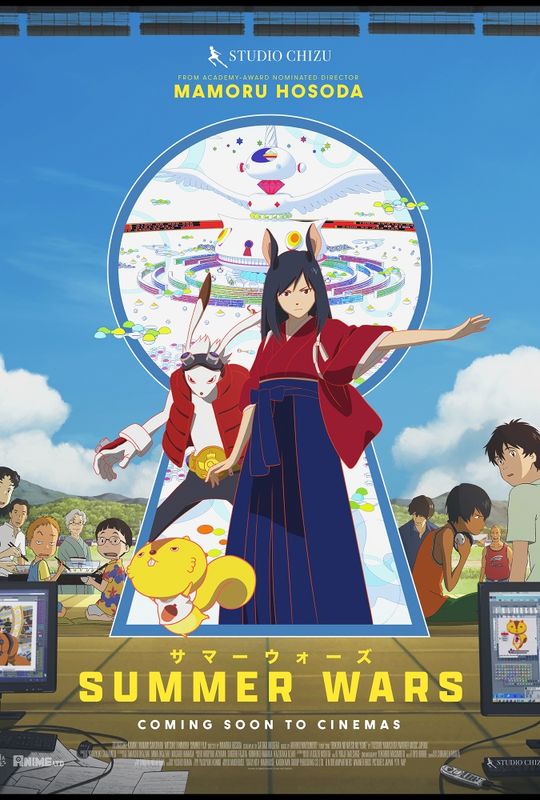
A country house full of relatives, endless meals, people shouting between rooms, the particular warmth of an enormous family gathering. Then, somewhere beyond the sliding doors and summer sunlight, a digital world starts to fall apart.
Summer Wars follows Kenji, a quiet maths-minded teenager who is invited to pose as a girl's boyfriend during a visit to her sprawling family. A serious crisis in the virtual world OZ soon turns their holiday into something much bigger. What makes the film special is the collision: family members who don't always get along, a very modern online emergency, and a sense that human relationships are going to matter more than any single piece of technology.
The visual feeling: Mamoru Hosoda moves between two beautifully different spaces. The real world is green, wooden and sunlit, full of ordinary objects and hot-weather stillness. OZ is all clean white space, bright colour and dazzling digital design. One feels inherited. The other feels built yesterday. Watching them collide is half the fun.
This is lively and often loud, not a quietly melancholic romance. Some of the online crisis may feel heightened, and the family scenes carry more of the heart than the love story. If you loved the everyday Japan around the supernatural events in Your Name, this gives you more of that texture, with a very different energy.
03 / 2021 · For colour, first love and late-summer music
Words Bubble Up Like Soda Pop
Signal.MD & Sublimation · Director Kyohei Ishiguro
Some films are blue because the sky is blue. This one seems to have discovered every colour that summer can possibly hold and decided to use them all.
Cherry is a shy boy who finds it easier to put his feelings into haiku than to say them aloud. Smile is outgoing online but uncomfortable with a part of herself she doesn't want others to notice. Their paths cross during one short summer, and an old record draws them into a gently unfolding connection. It's a small story, but the place around it feels wonderfully alive.
The visual feeling: Flat, confident colour is the point. Saturated pinks, teal shadows, citrus-bright yellows, graphic skies and little details from everyday spaces. It is almost the opposite of the photographic rain and glistening asphalt in Weathering With You, yet it creates the same ache for a particular time and place. Music, records and the simple courage of expressing a feeling hold the story together.
If you want the cosmic stakes of Suzume, you won't find them here. The charm lives in awkwardness, ordinary kindness and a modest romance. It is one of the gentlest starting points on this list, and an especially good choice when you're in the mood for warmth rather than heartbreak.
04 / 1995 · For the city you knew before it changed
Whisper of the Heart
Studio Ghibli · Director Yoshifumi Kondo
A library card. A familiar train. A little antique shop. A cat that seems to know more than it should. In Whisper of the Heart, the adventure begins with things small enough that an adult might walk straight past them.
Shizuku loves books and is curious about the name she keeps finding in the borrowing records. Following that curiosity eventually leads her towards Seiji and towards a more difficult question: what should she try to make of her own life? The film is romantic, but its real tenderness lies in watching a young person begin to take creativity seriously, even when it feels embarrassing to be a beginner.
The visual feeling: Yoshifumi Kondo's Tokyo is warm and lived in. Streets turn corners, bicycles climb hills, kitchens glow at night and light pools in the corners of rooms. It doesn't need a supernatural disaster to turn a sunset into an event. If you love the ordinary station platforms and neighbourhood streets in Shinkai's films, this is an older, quieter relative.
It's more about growing up and learning to make things than saving somebody across time. There is a gentle romance and a fantastic imaginative sequence, but much of the film stays grounded. Keep it for an evening when you want to feel inspired to start something imperfect of your own.
05 / 2021 · For music, optimism and an unexpected friendship
Sing a Bit of Harmony
J.C.Staff · Director Yasuhiro Yoshiura
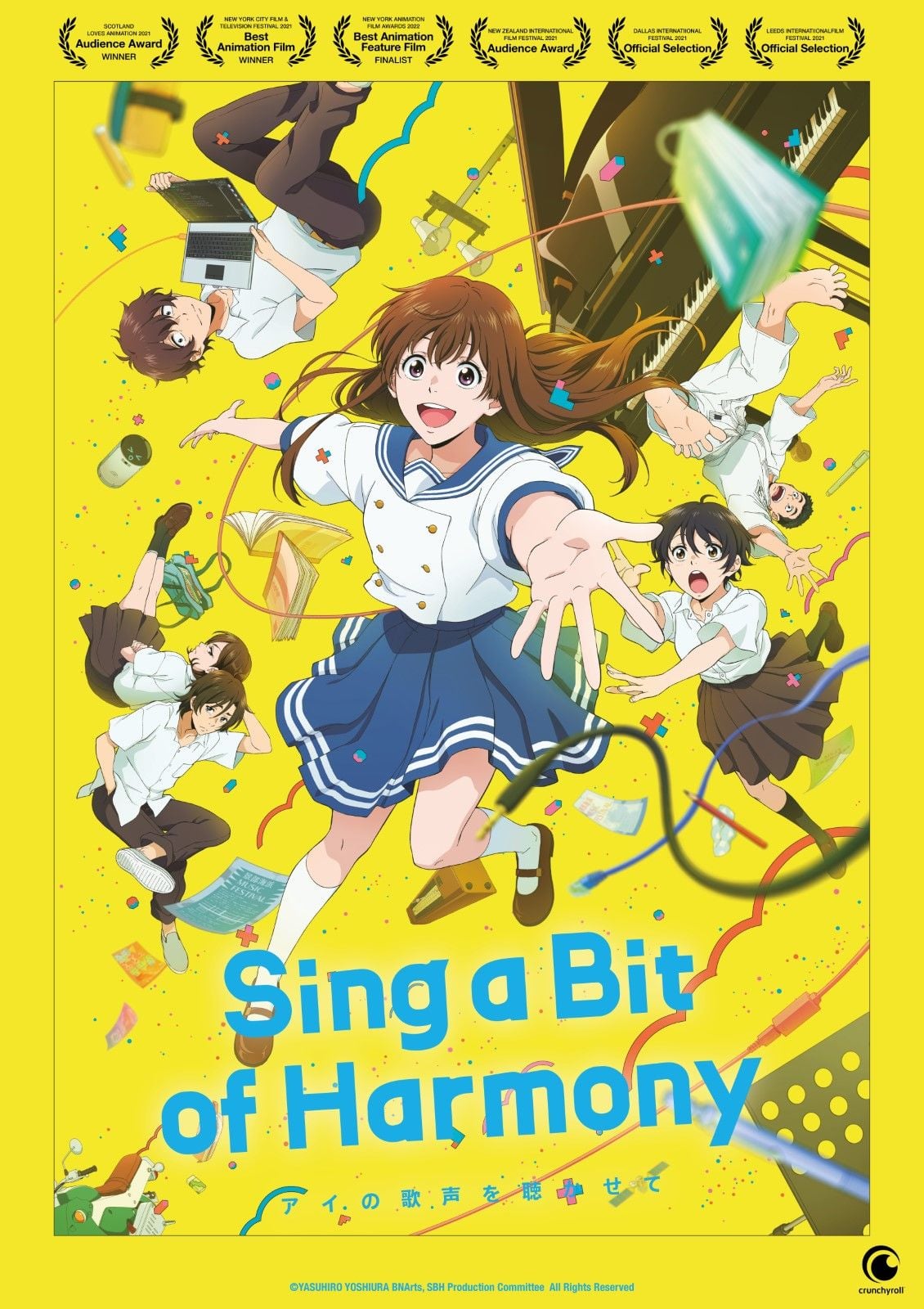
What if somebody arrived in your life with an almost unreasonable determination to make you happy, and their chosen method was to burst into song at the least convenient moments?
Shion appears at a school and immediately does everything a well-behaved new student probably shouldn't. She's cheerful, direct, mysteriously capable, and not quite what she seems. The audience learns that she is an experimental artificial intelligence, but the film's emotional centre is simpler: the way one unexpected friendship can rearrange a group of people who thought they already knew their place.
The visual feeling: Yasuhiro Yoshiura, who also directed Patema Inverted, stages songs and mechanical surprises with real affection. Everyday school life keeps opening into bursts of colour, movement and possibility. There's something especially nice about a film whose music is part of the storytelling rather than just an emotional layer laid on top of it.
It is a musical. If spontaneous singing makes you cringe, some scenes might test you before they win you over. The plot also becomes more adventurous than the early school-life setup suggests. If you like an optimistic, heartfelt story that isn't afraid to be a little earnest, give it a chance.
To Every You I've Loved BeforeTo Me, the One Who Loved You
06 + 07 / 2022 · For two love stories that change each other
To Every You I've Loved Before + To Me, the One Who Loved You
BAKKEN RECORD & TMS Entertainment · Two connected films
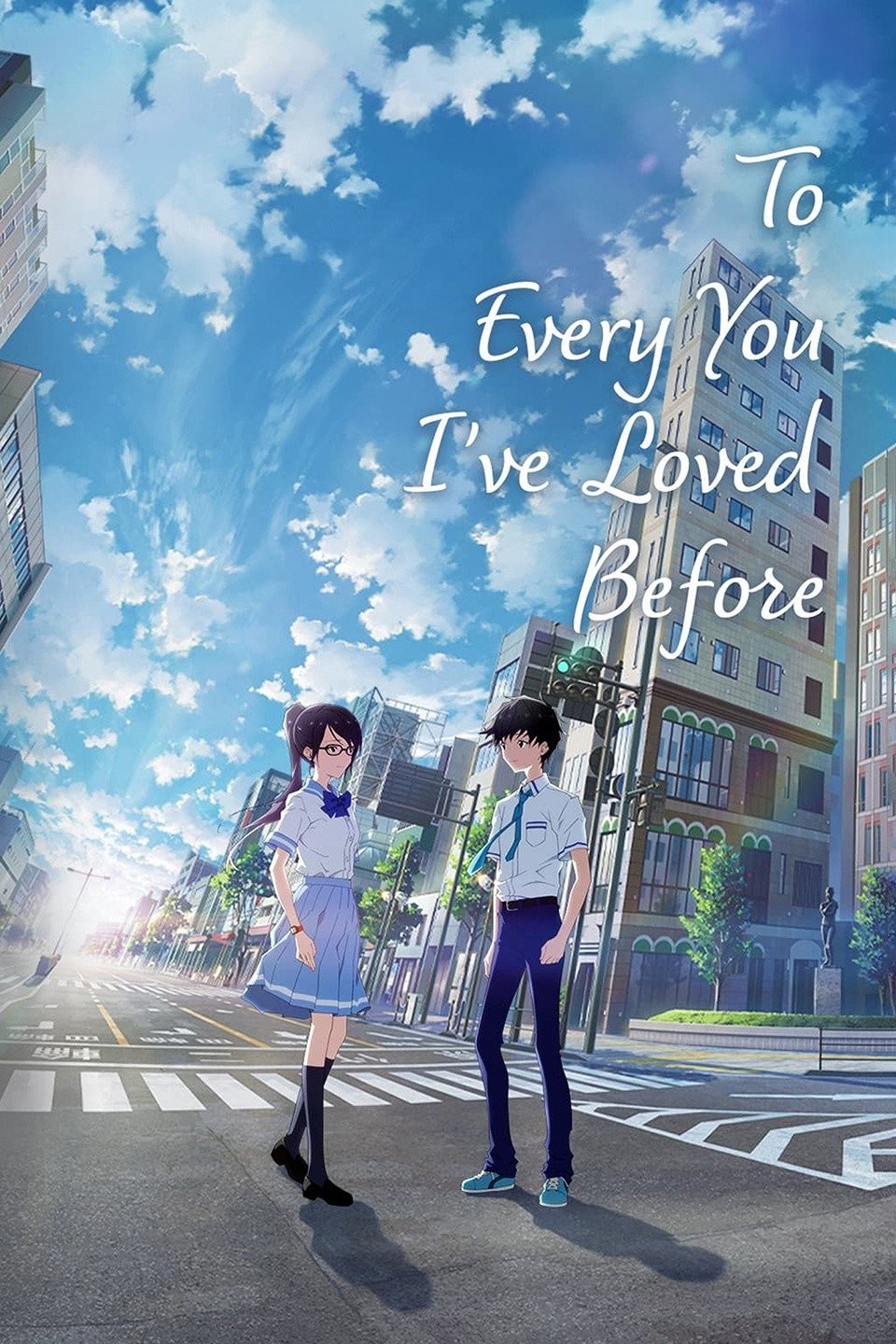
Two films, released together, built around the same impossible question: if more than one version of your life existed, could you love the same person in all of them? More importantly, would the choices that mattered to you in one world still matter in another?
To Every You I've Loved Before follows Koyomi Takasaki and a girl who says she knows him from another world. Its companion, To Me, the One Who Loved You, follows another version of Koyomi and a love complicated by family circumstances and the possibility of escaping into a parallel universe. The stories meet in ways best discovered rather than explained in a recommendation.
The visual feeling: The striking thing is how familiar everything looks. The station crossings, ordinary school days and illuminated streets could almost belong to any quiet Japanese romance. Then one idea changes the stakes of every glance. If Your Name made you care about how two lives might fit together across something larger than themselves, this pair is an interesting next experiment.
Which should you watch first? Either is a valid starting point. The original author said that the order changes how the stories feel. For a first viewing, we'd start with To Every You I've Loved Before, then watch To Me, the One Who Loved You fairly soon afterward, but there isn't a single official 'correct' sequence. Choosing the other order is part of the experience, not a mistake.
Think of this as one two-film commitment rather than two standalone comfort watches. The parallel-world ideas demand attention, and loss and grief are part of the story. An Australian classification of the paired release also notes mild nudity, among other mild material. Better for an evening when you want to be absorbed than when you need something uncomplicated.
08 / 2013 · For that vertigo you get looking at the sky
Patema Inverted
Studio Rikka · Director Yasuhiro Yoshiura
Once you understand the premise, you will probably spend the rest of the film wondering which way is down. Patema comes from an underground world where gravity behaves differently. When she meets Age on the surface, their different directions turn an ordinary gesture like holding somebody's hand into a matter of survival.
The visual trick is extraordinarily simple and powerful. Buildings become cliffs. The sky becomes a place you could fall into. An embrace becomes both affection and the only thing keeping someone safe. There's adventure, a dangerous authoritarian society and a mystery to understand, but that physical sensation is what gives the romance its own language.
Studio Rikka's own introduction to the film explains how the team built the story around one beautifully odd rule: the heroine's gravity runs the wrong way. It's a lovely example of a visual idea shaping a whole world instead of merely decorating it.
The visual feeling: This is perhaps the closest to Weathering With You on the very specific subject of feeling that the weather and the heavens might swallow you. The sky is a character. Where Shinkai often makes the clouds luminous and inviting, Yoshiura makes a bright blue afternoon look terrifying, then strangely beautiful.
It's a sci-fi adventure with pursuit and threat, not simply a soft romance. The construction of the world is the hook; some viewers may wish for more time with the quieter details. If the idea of falling upward makes you uncomfortable, expect to feel that on purpose.
09 / 2018 · For a story about the time we think we have
I Want to Eat Your Pancreas
Studio VOLN · Director Shinichiro Ushijima
The title is deliberately startling. The story beneath it is much quieter, and much sadder, than it sounds. An introverted boy discovers that his classmate Sakura is living with a serious pancreatic illness. She knows something about the fragility of her future that most of her classmates do not. He finds himself drawn into days that become important precisely because they cannot be kept.
There are little trips, ordinary conversations, bursts of humour and the awkwardness of two people who approach life very differently. The film is interested in the distance between knowing that time matters and actually living as though it does. It's romantic in a broad, deeply human sense, even when its relationships resist the simplest labels.
The visual feeling: Soft light, spring skies, streets lined with cherry blossom and the delicate sense that a beautiful scene can be over before you're ready. The film's colour is gentler than Suzume's or Bubble's, but the melancholy will be familiar to anyone who loves a fantastical anime romance for what it says about ordinary life.
This is not a light or cosy film. Serious illness, mortality and grief are central, not a twist to spring on someone looking for gentle entertainment. Don't choose it simply because the poster is full of blossoms. Choose it on a night when you want to let a film hurt a little, and you've got room for that.
Except for the two interconnected films, no. Start with the feeling you want. If you've just finished Weathering With You and want another impossible-looking city, put on Bubble. If you want the quieter, everyday part of Your Name, choose Whisper of the Heart. If you want someone to turn the lights up and fill the screen with summer, try Words Bubble Up Like Soda Pop.
The two parallel-world films really are a pair. Their creator explicitly invited people to choose which one they see first, because order changes the emotional experience. We would watch them on the same weekend and keep that little experiment intact.
A note on content and finding somewhere to watch
Anime artwork can make a film look gentler than its story. I Want to Eat Your Pancreas centres serious illness and grief. Patema Inverted has frightening situations and authoritarian violence. Summer Wars includes peril and intense digital-action sequences. Bubble has peril and loss. The parallel-world pair includes difficult emotional themes; the paired Australian release has a PG classification mentioning mild nudity. None of that necessarily makes a film unsuitable for you, but you deserve to know the emotional temperature before choosing a Saturday-night watch.
Bubble and Words Bubble Up Like Soda Pop have official UK Netflix pages. Other availability can vary by country, subscription and month. We have linked to official film, distributor or store pages rather than promising that a film is currently included with a particular service when that can change.
Make an evening of it, not a checklist
It's tempting to line up nine films and turn the whole thing into a project. But these stories work best when you give them the evening they deserve. Watch one, let the music finish, and don't immediately reach for the next recommendation.
We make Calphii, a little digital workspace where music, ambience and visual worlds share space with the tools you use to work or study. We care a lot about the feeling of being somewhere, even when that somewhere is a screen. Anime films are an enormous inspiration in that respect: the power of a window, a quiet room, a rainy street, the particular shade of a night sky.
When the work is done, close your tasks, settle into a room you like, and give a good film your full attention. We're fond of little indie-game worlds for much the same reason.
A small Calphii thought Some stories make a place feel familiar before you've ever been there. Perhaps that's why we carry them around for so long afterward.
Keep reading
A good next read
You don't have to change everything at once. Here are a few related pieces if you want to follow the thought a little further.